A bunch of stuff blew up yesterday, but not much was made of it. The bombings are likely done by Sunni extremists trying to incite civil war 2006 style (pure speculation on my part).
But nobody made a big deal about it-- after all, it is Iraq, and as callous as it may sound, things do tend to blow up from time to time. All the news reports (American; the Iraqis didn't make much of it) painted a picture of doom and gloom, and hinted we were taking steps backwards. My view (tunneled through my Iraqi unit) is that they are as good as they are willing to let us make them, and from here they have to figure it out for themselves.
Except this one, which I thought paints an accurate picture: http://www.newsweek.com/id/211298
Yesterday I went to the big American base by the airport for a logistics run, and I had to go see finance to get a pay issue resolved. Life looked overly normal there. Those people are fighting a different war. It looks like we imported a US Garrison state and mindset, complete with buffed floors, EO Policy bulletin boards, and flyers for salsa nite at MWR. Makes you wonder how we are ever going to get all that nice living crap home by 2012.
It was another day in Iraq, I suppose, and there are only less than 70 left.
Hope all's well- take care.
Ron
Monday, August 10, 2009


Friday, August 7, 2009
The officials spoke on condition of anonymity because they were not authorized to talk to the media
That's my favorite line for every news story coming out of Iraq these days. Makes you wonder about their sources.
It has been a good week for the Brigade. This week was the Shiite Muslim holiday of Shabaniya, which involves yet another pilgrimage to Karbala for a celebration of the birth of the 12th Imam, who never really died, and who is supposed to come back like Jesus. Not as many walkers as Arba'een, maybe the heat has something to do with it. It was a big show in Karbala, and one that involved a tremendous amount of security along the march route, which was right outside our door. There were no incidents in the Brigade's sector, another tribute to their growing ability to execute and provide security for their area. We as Americans decided to lay low on this one, and the IA had complete autonomy, with little to no Americans present outside. While there was violence in the country (some smaller bombs in Baghdad, and one up north) the march overall went off unopposed. As callous as it may sound, it is a Muslim country, and things do tend to explode from time to time in Muslim countries. In our area, security continues to improve.
Here's me on an aerial recon of the pilgrimage:
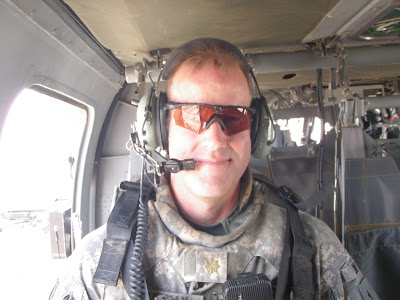
We even did two things at once this week! The Brigade's Mortar Battery was selected in a competition to "compete in the finals" against another Brigade for top Mortar Battery Honors. The Battery has been working hard, and two guys on our team have been in the shadows advising as needed, but they aren't needed much. Not sure what the winners get, but I bet it involves a big trophy for the Brigade Commander's office, and not much of anything for the soldiers. Such is the way of the IA...
I'll be honest; we are getting bored and running out of ideas and stuff to work with them on. What they do isn't perfect, but it works for them.
We have a week before Ramadan (yet ANOTHER Muslim holiday) starts. It will be another big test for the Brigade, but I think they will do ok.
Hope all's well- take care.
Ron
Monday, August 3, 2009
Occasionally things do go right
I'm a little late in posting this, but better late than never.
The one area that took us the longest to get after was training. The Brigade was averse to conducting any kind of initial, supplemental, or sustainment training until about June, when we finally cracked the nut. The Brigade Commander now sees the value in scheduling and executing training to make his soldiers better. If we could only get him to resource it, it would be nirvana, or as close to nirvana as we are going to get.
We conducted a three week Commando course for five soldiers per Battalion and soldiers at the Brigade. The intent of the training was to create 'train the trainers' so the students would then go back and teach what they learned to their Battalions. The actual training was fairly simple-- regular "10 level tasks" that our initial entry Soldiers do every day, and the Junood picked it up well. Topics included map reading, urban operations, tactical movements, support by fire positions, marksmanship, and first aid. The event culminated in a graduation "capstone" exercise complete with live ammunition. The big victory was getting the IA to buy into the training idea, and then getting the IA to conduct the training. The real lessons were that the IA leadership learned a lot about how to conduct training. On Thursday, 30 July, we graduated 28 from our first class.
The one area that took us the longest to get after was training. The Brigade was averse to conducting any kind of initial, supplemental, or sustainment training until about June, when we finally cracked the nut. The Brigade Commander now sees the value in scheduling and executing training to make his soldiers better. If we could only get him to resource it, it would be nirvana, or as close to nirvana as we are going to get.
We conducted a three week Commando course for five soldiers per Battalion and soldiers at the Brigade. The intent of the training was to create 'train the trainers' so the students would then go back and teach what they learned to their Battalions. The actual training was fairly simple-- regular "10 level tasks" that our initial entry Soldiers do every day, and the Junood picked it up well. Topics included map reading, urban operations, tactical movements, support by fire positions, marksmanship, and first aid. The event culminated in a graduation "capstone" exercise complete with live ammunition. The big victory was getting the IA to buy into the training idea, and then getting the IA to conduct the training. The real lessons were that the IA leadership learned a lot about how to conduct training. On Thursday, 30 July, we graduated 28 from our first class.
The big victories in this short video are controlled fire, controlled movement, and somebody in charge-- All rarities in regular IA operations. These guys worked together pretty well, and they worked hard over the course of three weeks to get this far. I wish I had a before video, but I don't.
Below is an article from the Stars and Stripes that says a lot about the Iraqi Security Forces and their abilities. The current Shabaniya pilgrimage to Karbala will be another "capstone" for the Brigade, and so far so good.
Security Pact gives Iraqi Security Forces a New Swagger - Heath Druzin, Stars and Stripes. Turki Atiah Thamer and Mohrfakh Ali Namdar rolled through Khadamiyah to inspect checkpoints in the well-worn Chevy pickup that is the trademark vehicle of the Iraqi National Police force, wagging an AK-47 out the window while waving traffic to pass. On the bustling streets of this Baghdad neighborhood, there’s no body armor, no hulking, blast-resistant trucks - and no American soldiers in sight. “Iraqis are taking over,” Thamer said. “The people appreciate that.” US troops have become a sort of nocturnal curiosity in Iraq’s cities, rarely seen except for the occasional camouflage mushroom of a helmet peeking out of a gunner’s hatch during a pre-dawn convoy. For a month now, since the June 30 pullback of American troops from urban areas to their bases, such convoys have been sharply restricted, operating only late at night and early in the morning - and then only with Iraqi approval. When they do roll, the Americans draw puzzled looks from local residents and the occasional unfriendly greeting from their Iraqi counterparts. In Khadamiyah, both a commercial and Shiite religious center, the differences from a few weeks ago are striking. Before June 30, Humvees and large armored trucks known as MRAPs ruled the roads and soldiers on foot patrol were a common sight. Under the new rules, US combat soldiers can patrol if their Iraqi counterparts request it - but it hasn’t happened.
Hope you are well. Take care-
Ron
Friday, July 31, 2009
A good assessment and I agree with the conclusion: It's time to attack in the other direction
Colonel Tim Reese is an advisor to the Baghdad Operations Center. Where I advise a Brigade, he advises the big heads two echelons up. He wrote a memo that was "leaked" to the press (New York Times, at that) explaining that US forces should declare victory and go home, since the current Government of Iraq (GOI) doesn't want us here anymore. Except to give them stuff. Militarily, we have ridden this thing about as far as its potential will take us.
Our team discussed the memo and for the most part we are in agreement. The Bike riding analogy towards the end is especially applicable. Maybe another appropriate analogy is a teenager with a car: He/she wants to drive, but doesn't want to pay for gas or insurance (or the car), doesn't know the limitations of the car and his/her ability to operate it, occasionally goes to unfamiliar neighborhoods and gets himself/herself into trouble and expects mom and dad to come and bail them out, then wrecks the car, and promptly demands a new one.
http://www.nytimes.com/2009/07/31/world/middleeast/31advtext.html?pagewanted=1&_r=1&ref=middleeast
We are gonna start loading our containers now. Off to pack!!!
Ron
Our team discussed the memo and for the most part we are in agreement. The Bike riding analogy towards the end is especially applicable. Maybe another appropriate analogy is a teenager with a car: He/she wants to drive, but doesn't want to pay for gas or insurance (or the car), doesn't know the limitations of the car and his/her ability to operate it, occasionally goes to unfamiliar neighborhoods and gets himself/herself into trouble and expects mom and dad to come and bail them out, then wrecks the car, and promptly demands a new one.
http://www.nytimes.com/2009/07/31/world/middleeast/31advtext.html?pagewanted=1&_r=1&ref=middleeast
We are gonna start loading our containers now. Off to pack!!!
Ron
Wednesday, July 29, 2009

Monday, July 27, 2009
Today was one of those days where I wonder if they will make it
So we have another muslim holiday called Shabaniya coming up, which is about the birth of the 12th Imam (I think I got that right). It involves another bigass pilgrimage right down the street in front of where we live down to Karbala. "Millions" will walk over about a 7-8 day stretch, although today I learned many aren't as faithful as Arba'een, as it is hot as blazes here (around 115 every day), so a lot of people will drive it this time.
So anyway, we are expecting a lot of foot traffic, and in a humanitarian effort, we (the Coalition) gave some bottled water to the Iraqi Army Brigade for them to distribute during the march. It makes them look good, it is a nice non-sectarian guesture, and hopefully it will alleviate some of the walking casualties that will no doubt occur from the heat.
Well, it appears the Division Commander did not approve of his Brigade getting water from the Coalition; he thought it should go to him. So he sent trucks and a forklift to the Brigade to take all of the water-- 54 pallets of it. Water is not a big deal to us, our supply lines have it coming out our ears, but to Iraqis, water is life. The water in town is not very drinkable (think Mexico/3d world country) and the people in the countryside get theirs from the severely polluted canals, that is, when there is water in the canals. His rationale was that he was going to hold it and later distribute it to the Brigade so they could later distribute it to the people. He was said he worried the Brigade would keep it for themselves.
Sure you were.
A quick Iraqi Logistics 101 class: Most of the IA still runs on a cash-based logistics system: Each IA unit is paid on the amount of soldiers it has, and that's what the unit uses to feed, house, outfit its unit. If the Brigade Commander is a good businessman, he gets good deals on food, furniture, office supplies, etc, and has money left over for area improvements, infrastructure, air conditioners, and stuff like that. This system circumvents a very inefficient logistics system, which is the biggest problem facing the IA today. It is also a potentially corrupt system, as the unit commander can skimp on things for the soldier and pocket the money, or steer his business towards specific contractors in return for kickbacks. So when a Division Commander gets his greasy palms on 64,000 bottles of free water, he doesn't have to buy bottled water for a long time.
My opinion: Water (and supplies in general) is power, and Iraqis love to hoard stuff. Stuff equals power ('wasta') and if I have something you don't I can hold it over your head. They do the same with information: It makes me have value-- if you know what I know, what good am I? Usually I refer to this behavior as "The Junior High Syndrome" as its logic is quite juvenile. It's also why Iraqis in general are so meeting averse and information sharing averse, which totally goes against our current trend of being an information sharing-based society.
It makes you wonder how a society lasted this long. Oh yeah, that's right-- Brutal dictatorship.
Another day. Hope you are well.
Ron
So anyway, we are expecting a lot of foot traffic, and in a humanitarian effort, we (the Coalition) gave some bottled water to the Iraqi Army Brigade for them to distribute during the march. It makes them look good, it is a nice non-sectarian guesture, and hopefully it will alleviate some of the walking casualties that will no doubt occur from the heat.
Well, it appears the Division Commander did not approve of his Brigade getting water from the Coalition; he thought it should go to him. So he sent trucks and a forklift to the Brigade to take all of the water-- 54 pallets of it.
Sure you were.
A quick Iraqi Logistics 101 class: Most of the IA still runs on a cash-based logistics system: Each IA unit is paid on the amount of soldiers it has, and that's what the unit uses to feed, house, outfit its unit. If the Brigade Commander is a good businessman, he gets good deals on food, furniture, office supplies, etc, and has money left over for area improvements, infrastructure, air conditioners, and stuff like that. This system circumvents a very inefficient logistics system, which is the biggest problem facing the IA today. It is also a potentially corrupt system, as the unit commander can skimp on things for the soldier and pocket the money, or steer his business towards specific contractors in return for kickbacks. So when a Division Commander gets his greasy palms on 64,000 bottles of free water, he doesn't have to buy bottled water for a long time.
My opinion: Water (and supplies in general) is power, and Iraqis love to hoard stuff. Stuff equals power ('wasta') and if I have something you don't I can hold it over your head. They do the same with information: It makes me have value-- if you know what I know, what good am I? Usually I refer to this behavior as "The Junior High Syndrome" as its logic is quite juvenile. It's also why Iraqis in general are so meeting averse and information sharing averse, which totally goes against our current trend of being an information sharing-based society.
It makes you wonder how a society lasted this long. Oh yeah, that's right-- Brutal dictatorship.
Another day. Hope you are well.
Ron
Saturday, July 25, 2009
90 And a Wakeup
As of today we have around 90 days left, which is a good thing. It is a chance to refocus and see if there is anything we still want to get after. It is also a chance to reflect and start thinking about sharing the experience with others who will follow us.
T.E. Lawrence had 27 Articles; David Kilcullen had 28 articles for Counterinsurgency. Ronald of Arabia should be no different, and I am up to 12 articles for my Counterinsurgency and Advising Experience:
1. Advising is Patience, Listening, Understanding and Timing/Opportunity. (I stole this from LTC Seagrist, former 9th IA MTT Chief, and it has become my common theme.) You must invest time in a relationship to be successful. Be patient, they will tell you their concerns, their problems, and what they want help with. What they want help with isn’t necessarily what they need help with. Take time to listen and really understand their position, and then seek the opportunity to pose solutions and recommendations to what needs to get fixed.
2. Relationships at all levels (ISF, Iraqis, adjacent unit, CF, BDE, BN, other MTTs, media, logistics people- everyone) are the key to getting things done as an advisor. Plan on being an extrovert.
2. It’s not about you. It’s not about your Coalition Force (CF) unit either. It’s not about numbers of named operations, numbers of bad guys the CF killed/captured, or how great of a job you are doing. American Soldiers are doing amazing things every day, but if you are not pimping your IA unit in everything you do, you are wrong.
3. You don’t own battlespace. It’s their country, and you should consult them if you are about to do something that they will have to conduct consequence management on.
4. This is not OIF 1, 3, 4, 7, or even 9. It's not OIF two months ago. It’s not like the last time you were here, it is completely different. What seemed like a good idea in 2005 is probably a really bad idea right now. Reassess often, and accept that change is good.
5. Vengeance will not solve the problem of the random explosion. Explosions are diversions to your real mission, which is focusing on the people and building ISF capacity.
6. Give the people what the insurgent can’t provide: Help the IA and GOI build capacity by working on Water, sewage, electricity, a shot at decent medical care, representation in government. If the ISF isn’t thinking in those terms, this is now your internal PSYOP campaign to influence them in this direction.
7. The people are the center of gravity. If the people are a cookie, the Sheiks are the extra special stuff in the middle of the Oero cookie. Don’t be fooled, they still run the show. Make sure you have IA/ISF representation when you deal with them, else they will either play you off against each other, or you will make a mess that the ISF will have to clean up/conduct consequence management on. It is also a good chance to put ISF In the lead. Besides, the ISF is way smarter than you when it comes to dealing with sheiks.
8. Think hard about giving the IA an enabler: Will they really use it? Or is it American technology designed to spy on the ISF? Does its injection inhibit the IA from doing it their way? If so, then don’t apply it. If it makes them look good, if it helps teach or reinforce a lesson, then by all means, offer them the moon.
9. The easy way is kinetic. The hard way is using the brain to figure out a solution that isn’t kinetic. “The violent way is the short way, and the peaceful way is the long way.” --COL Bill Rapp, Advisor to GEN Petraeus during the surge. I am convinced that long, boring and slow is how we will win.
10. American solutions and TTPs are just that: Solutions for Americans. Don’t get offended if the ISF don’t take your advice. Keep trying, throw more spaghetti at the wall and accept some of it will stick and some of it won’t. Reinforce and exploit success where the spaghetti sticks.
11. The IA leads everywhere. They are the most effective counter IED device in country.
12. Not everyone will hit their stride or start making an impact immediately, and this isn’t necessarily bad. It will take some on your team up to 9 months to have an impact. What will matter is the persistence of the advisor when confronted with continued negativity. Patience and persistence will win out, if you are patient and persistent enough…
I'll try to come up with more. For those getting ready to make the trip, I hope it helps.
Take care-
Ron
T.E. Lawrence had 27 Articles; David Kilcullen had 28 articles for Counterinsurgency. Ronald of Arabia should be no different, and I am up to 12 articles for my Counterinsurgency and Advising Experience:
1. Advising is Patience, Listening, Understanding and Timing/Opportunity. (I stole this from LTC Seagrist, former 9th IA MTT Chief, and it has become my common theme.) You must invest time in a relationship to be successful. Be patient, they will tell you their concerns, their problems, and what they want help with. What they want help with isn’t necessarily what they need help with. Take time to listen and really understand their position, and then seek the opportunity to pose solutions and recommendations to what needs to get fixed.
2. Relationships at all levels (ISF, Iraqis, adjacent unit, CF, BDE, BN, other MTTs, media, logistics people- everyone) are the key to getting things done as an advisor. Plan on being an extrovert.
2. It’s not about you. It’s not about your Coalition Force (CF) unit either. It’s not about numbers of named operations, numbers of bad guys the CF killed/captured, or how great of a job you are doing. American Soldiers are doing amazing things every day, but if you are not pimping your IA unit in everything you do, you are wrong.
3. You don’t own battlespace. It’s their country, and you should consult them if you are about to do something that they will have to conduct consequence management on.
4. This is not OIF 1, 3, 4, 7, or even 9. It's not OIF two months ago. It’s not like the last time you were here, it is completely different. What seemed like a good idea in 2005 is probably a really bad idea right now. Reassess often, and accept that change is good.
5. Vengeance will not solve the problem of the random explosion. Explosions are diversions to your real mission, which is focusing on the people and building ISF capacity.
6. Give the people what the insurgent can’t provide: Help the IA and GOI build capacity by working on Water, sewage, electricity, a shot at decent medical care, representation in government. If the ISF isn’t thinking in those terms, this is now your internal PSYOP campaign to influence them in this direction.
7. The people are the center of gravity. If the people are a cookie, the Sheiks are the extra special stuff in the middle of the Oero cookie. Don’t be fooled, they still run the show. Make sure you have IA/ISF representation when you deal with them, else they will either play you off against each other, or you will make a mess that the ISF will have to clean up/conduct consequence management on. It is also a good chance to put ISF In the lead. Besides, the ISF is way smarter than you when it comes to dealing with sheiks.
8. Think hard about giving the IA an enabler: Will they really use it? Or is it American technology designed to spy on the ISF? Does its injection inhibit the IA from doing it their way? If so, then don’t apply it. If it makes them look good, if it helps teach or reinforce a lesson, then by all means, offer them the moon.
9. The easy way is kinetic. The hard way is using the brain to figure out a solution that isn’t kinetic. “The violent way is the short way, and the peaceful way is the long way.” --COL Bill Rapp, Advisor to GEN Petraeus during the surge. I am convinced that long, boring and slow is how we will win.
10. American solutions and TTPs are just that: Solutions for Americans. Don’t get offended if the ISF don’t take your advice. Keep trying, throw more spaghetti at the wall and accept some of it will stick and some of it won’t. Reinforce and exploit success where the spaghetti sticks.
11. The IA leads everywhere. They are the most effective counter IED device in country.
12. Not everyone will hit their stride or start making an impact immediately, and this isn’t necessarily bad. It will take some on your team up to 9 months to have an impact. What will matter is the persistence of the advisor when confronted with continued negativity. Patience and persistence will win out, if you are patient and persistent enough…
I'll try to come up with more. For those getting ready to make the trip, I hope it helps.
Take care-
Ron
Subscribe to:
Posts (Atom)


